
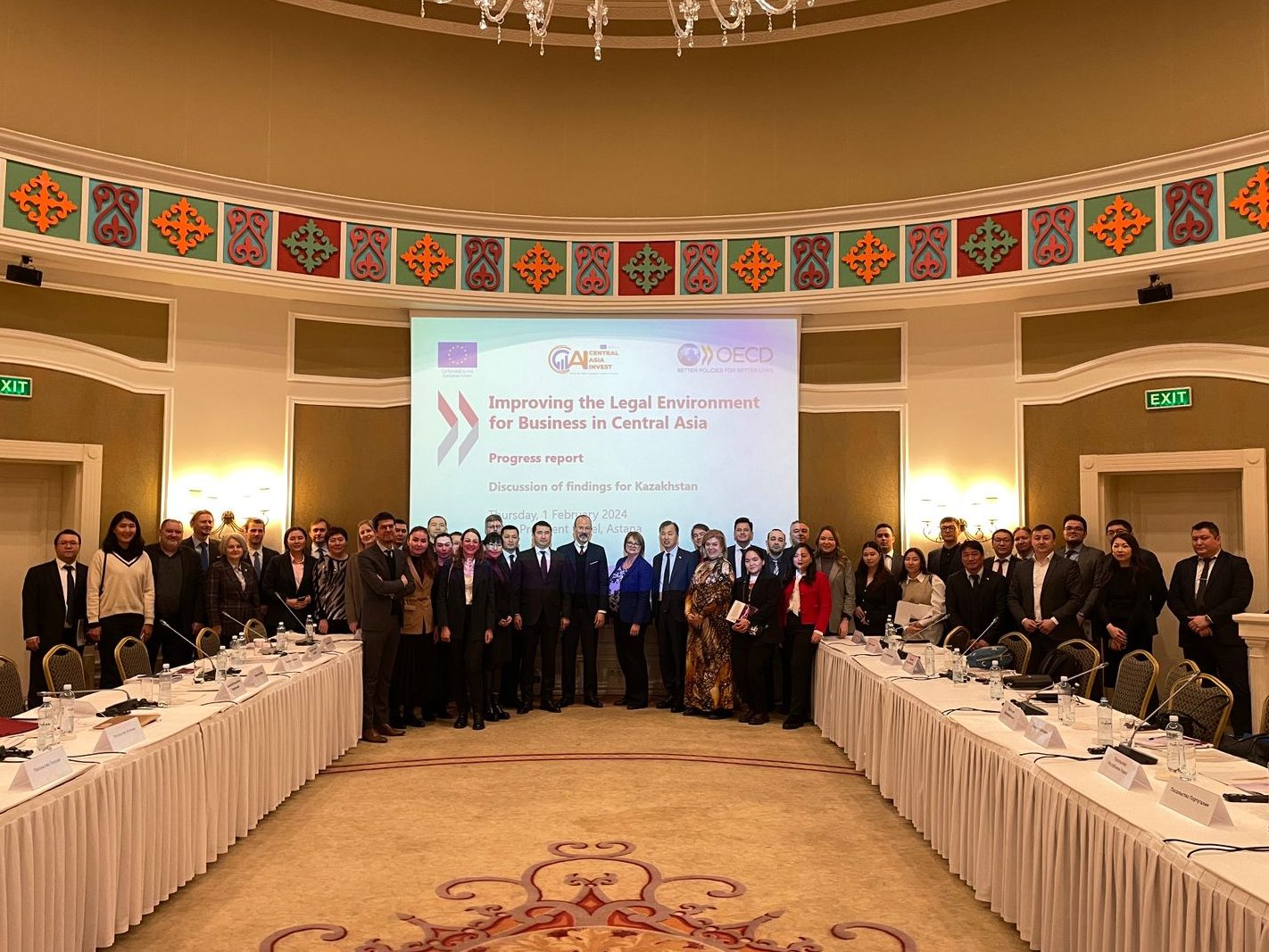
On 1 February 2024, in the framework of the EU-funded Central Asia Invest programme, the Organisation for Economic Cooperation and Development (OECD) organised a dissemination seminar to present the findings of the progress report looking at improvements in the legal environment for business in Kazakhstan and the wider Central Asia region, following the June 2023 seminar discussing the preliminary findings. This work follows a study that the Organisation conducted in 2019-2020 on Improving the Legal Environment for Business and Investment in Central Asia. The event was held in co-operation with the Government of the Republic of Kazakhstan and the European Union, donor to the project.
Mr Youri Skaskevitch, Programme Manager at the Delegation of the European Union to Kazakhstan, opened the seminar and highlighted the timeliness of the OECD’s work in the current international context. Amidst mounting uncertainty and instability, increasing economies’ resilience appears critical to foster investment attractiveness and support private sector development. He reiterated the European Union’s support to Kazakhstan in its business environment reform efforts, together with other international partners.
Mr Abzal Abdikarimov, Vice-Minister of National Economy of the Republic of Kazakhstan, also provided opening remarks to the seminar. He expressed its gratitude to the OECD and the European Union for their support and contribution in improving economic reforms in Central Asia. He mentioned that a National Contact Point (NCP) for Responsible Business Conduct (RBC) had recently been launched in Kazakhstan as part of the country’s efforts to implement OECD standards and to disseminate responsible business conduct practices. He more widely described the country’s ongoing work with the OECD in areas such as public governance, sustainable infrastructure, and integrity, among others.
Mr Grégory Lecomte, Head of the OECD’s Central Asia Unit, then presented progress made in the business environment in the other countries of Central Asia. He explained that all countries of the region had made some progress in streamlining administrative procedures such as licenses and permits, digitalised public services and reinforced regional integration through the improvement of customs and border procedures. Among challenges ahead, he highlighted the importance of ensuring predictability and consistency of the application of legislation, fostering competition and SOE reforms, and extending the use of monitoring and evaluation and regulatory impact assessment for evidence-informed policy-making.
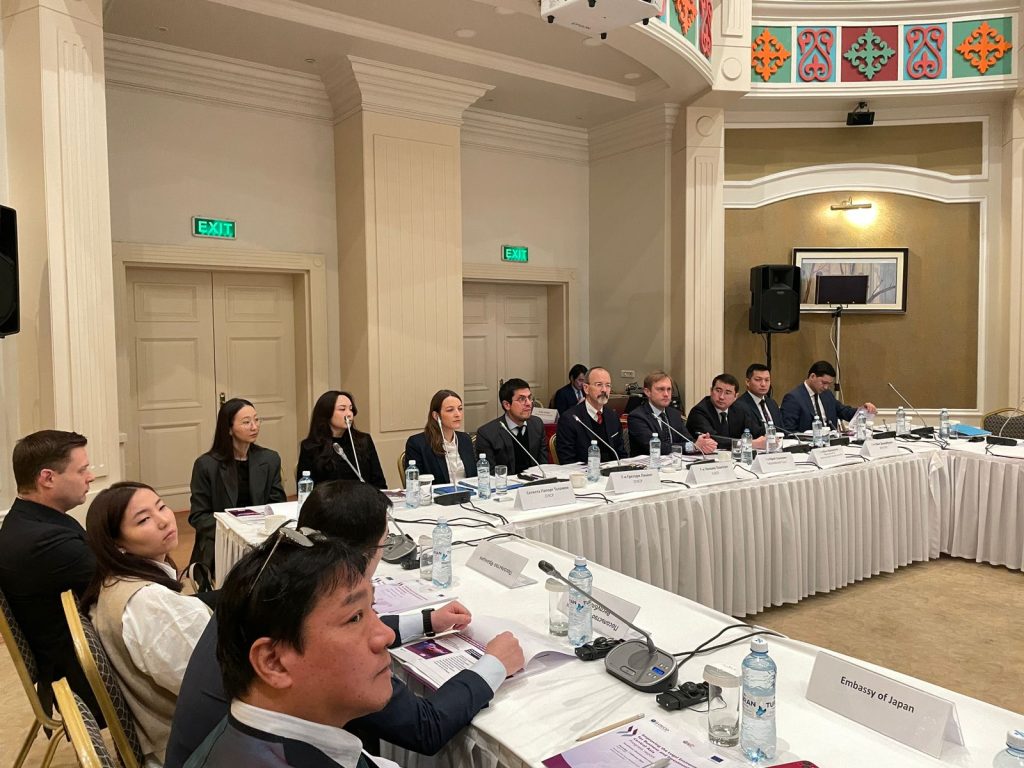
Ms Céleste Laporte Talamon, Policy Analyst at the OECD, then presented the findings from the report on Kazakhstan in particular. Among other things, she mentioned the importance of stabilising regulation with a focus on analysing the impact on SMEs to improve the operational environment for firms. She also emphasised the need to monitor the implementation of judicial reforms to improve contract enforcement, and advocated for a rationalisation of services trade regulation to remove unnecessary restrictions to regional trade.
Mr Erik Djambulov, Director of the Business Development Policy Department at the Ministry of National Economy of the Republic of Kazakhstan, provided comments on the findings on behalf of the Government of Kazakhstan. He acknowledged that firms sometimes face unnecessary hurdles in conducting business and mentioned the government’s recent reforms to remove administrative barriers. For instance, he described the new Concept for the Development of SMEs which serves to clarify mandatory requirements regulating entrepreneurial activity. He also mentioned that work had been carried out to automate risk management systems using artificial intelligence, as a result of which inspections will be scheduled without human intervention.
Presentations are accessible at the following links in English and Russian.